
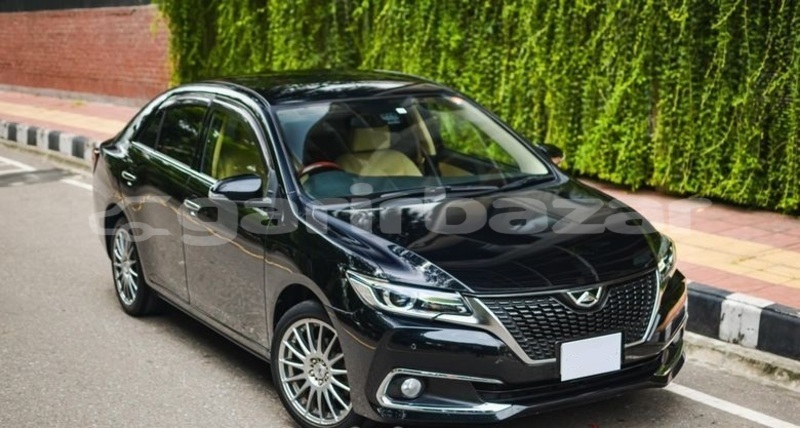
The Toyota Allion and Toyota Premio are twin sedans sold exclusively in the Japanese domestic market between 2001 and 2021. Both share the same platform, engines, and mechanical components — the difference lies primarily in styling and target buyer demographic. The Premio is marketed as the more conservative, formal choice (often associated with older buyers), while the Allion has a slightly sportier exterior treatment aimed at younger professionals. In 2026, both models remain highly popular in export markets across East Africa, Southeast Asia, and the Pacific, prized for Toyota reliability, spacious interiors, and competitive used car prices.
Toyota Allion vs Toyota Premio: Key Differences
Feature
Toyota Allion
Toyota Premio
Front grille style
Sportier, more angular
Conservative, formal
Rear styling
Slightly more dynamic
Traditional three-box
Interior trim
Similar — both high quality
Slightly more upscale feel
Target market
Younger professionals
Mature, traditional buyers
Export popularity
Very high
Very high
Resale value
Comparable
Comparable
Shared Specifications (Both Models)
Because the Allion and Premio share platforms and drivetrains entirely, their mechanical specifications are identical across equivalent trim levels:
Engine Options
- 1.5L four-cylinder (1NZ-FE): 109 hp — economy choice, front-wheel drive only
- 1.8L four-cylinder (2ZR-FE): 144 hp — best balance of performance and economy
- 2.0L four-cylinder (1AZ-FSE / 3ZR-FAE): 145–158 hp — most powerful option
Transmission
- CVT (Continuously Variable Transmission) on most 2007+ models
- 4-speed automatic on early (2001–2006) models
- Manual transmission option on select 1.5L trims
Drivetrain
- Front-wheel drive (standard on all variants)
- 4WD available on select 1.8L and 2.0L trims — rare and commands a premium
Dimensions
- Length: approximately 4,570–4,620 mm depending on generation
- Width: 1,695 mm
- Wheelbase: 2,700 mm — generous for a compact sedan
- Seating: 5 passengers
- Boot capacity: approximately 530 litres
Fuel Economy
- 1.5L: Approximately 16–18 km/L (JC08 cycle)
- 1.8L: Approximately 14–16 km/L
- 2.0L: Approximately 12–15 km/L
The 1.8L variant offers the best overall value — adequate power with good fuel economy, and the widest availability in the used export market.
Generation Guide
First Generation (2001–2007)
Reliable workhorse generation. 4-speed automatic on most models. Look for units with service history; timing chain (not belt) on most 1.8L and 2.0L engines. Auction grades of 3.5–4.5 common. FOB Japan price: USD 3,000–7,000.
Second Generation (2007–2021)
CVT introduced, improving fuel economy. Improved interior quality and safety features. More modern infotainment options on later models. This generation dominates the used export market in 2026. FOB Japan price: USD 5,000–12,000 depending on year and trim.
Which Should You Buy?
Given identical mechanical specifications, the choice comes down entirely to styling preference:
- Choose the Allion if you prefer a slightly sportier exterior or plan to use the car for personal transport where visual impression matters
- Choose the Premio if you prefer a more formal, conservative look — popular in markets where government or executive transport is the use case
- In most export markets, price is the deciding factor — buy whichever presents better value at auction
What to Check Before Buying
- Verify chassis number against Toyota's VIN database — confirm 1.8L vs 2.0L engine
- Request auction sheet — Grade 4 or above recommended for personal use
- Check CVT condition: CVT failures on high-mileage units (over 150,000 km) are the most common mechanical issue
- Inspect for D4 engine carbon buildup on direct-injection 2.0L (1AZ-FSE) models
- Confirm air conditioning function — critical in tropical export markets
- Check for water leak signs around windscreen seal — a known age-related issue on both models
2026 Used Market Pricing (FOB Japan)
- 2001–2006 (1st gen), Grade 4: USD 3,500–6,000
- 2007–2012 (2nd gen early), Grade 4: USD 5,500–8,500
- 2013–2018 (2nd gen late), Grade 4: USD 7,000–11,000
- 2018–2021 (final production), Grade 4+: USD 10,000–14,000
Bottom Line
The Toyota Allion and Toyota Premio are mechanically identical — your choice depends on exterior styling preference and whichever unit offers better value at the time of purchase. Both deliver Toyota's benchmark reliability, spacious interiors for the class, and strong parts availability globally. For buyers in East Africa and Southeast Asia, the 1.8L second-generation models (2007–2018) represent the sweet spot: modern enough for fuel economy and comfort, affordable enough for the used export market, and durable enough for demanding road conditions.
- Mechanical winner: Tied — identical drivetrains
- Styling: Allion (sportier) vs Premio (formal) — choose based on personal preference
- Best value spec: 1.8L CVT, second generation (2007–2018), Grade 4 auction
- Watch out for: CVT wear on high-mileage units; D4 carbon buildup on 2.0L direct injection