
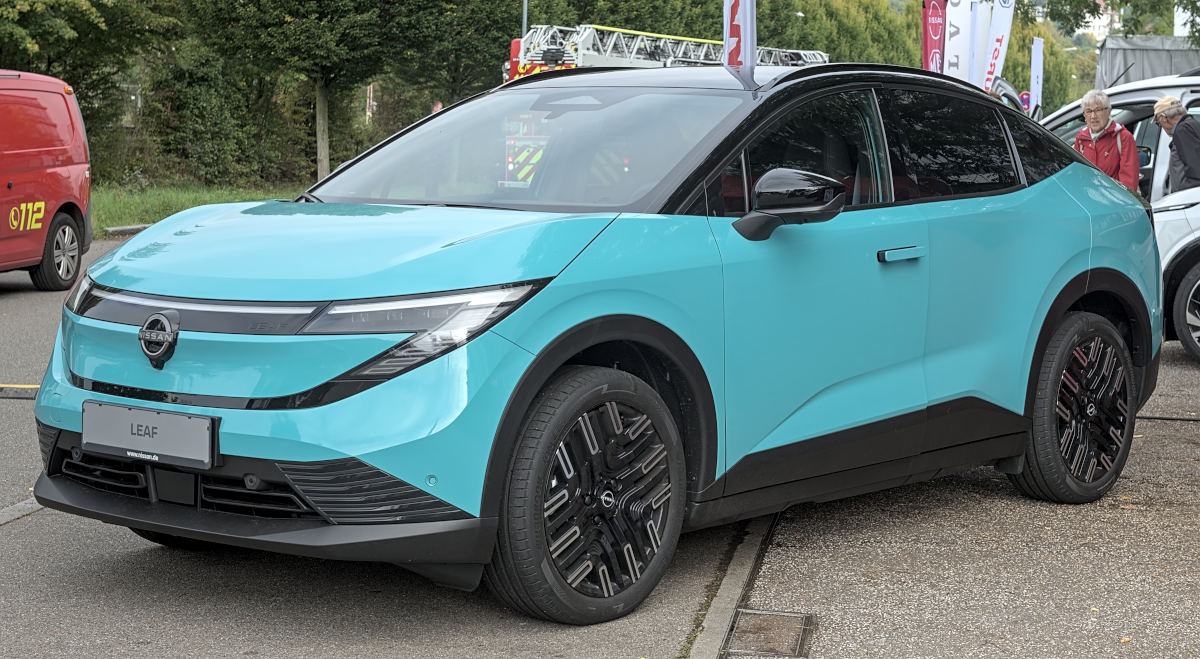
A used Nissan Leaf is one of the most affordable ways to drive electric in a city, and Japan has a large supply of them. This guide explains what a 2020 Leaf with the 40 kWh battery is like for urban driving: real range, how charging works at home and in public, what it costs to run compared with a petrol car, and how to check the battery before you buy. It is written for buyers in Japan and for importers in the Middle East and Africa who are considering a first electric vehicle.
Which Leaf: the 2020 40 kWh model
The second-generation Leaf (2017 onwards) with the 40 kWh battery is the most common used Leaf exported from Japan. Its official WLTP range is about 270 km. In everyday city driving, expect roughly 180–230 km depending on temperature, speed and air-conditioning use. That comfortably covers most urban routines, where daily driving is often under 100 km.
Prices at Japanese auctions vary with mileage, grade and battery health, so check current auction results or ask an exporter for recent sales before budgeting. Remember to add shipping, import duty and registration costs in your country.
Charging: the key to living with an EV in a city
The single biggest factor is whether you can charge at home or at work.
- Household socket: slow, adding roughly 5–15 km of range per hour depending on your mains voltage (100 V sockets in Japan are at the slow end; 230 V sockets common in the Middle East and Africa are faster). Enough to top up overnight after a typical commute, but not to refill an empty battery.
- Home wallbox: the Leaf's on-board charger accepts about 6.6 kW, so a wallbox refills an empty 40 kWh battery in roughly 7–8 hours, which is overnight.
- Public fast charging: the Leaf uses the CHAdeMO standard. CHAdeMO chargers are widespread in Japan, but availability elsewhere varies a lot by country and city. Check charger maps for your area before buying, especially where networks are still small.
Running costs vs. a petrol car
To compare running costs, multiply your electricity price by the energy used. As a rough example, the Leaf typically uses around 15–18 kWh per 100 km in city driving. At an electricity price of 30 yen per kWh, that is about 4.5–5.5 yen per km. A petrol car averaging 18 km/L with fuel at 170 yen per litre costs about 9.4 yen per km. On those assumptions, the Leaf costs roughly half as much per kilometre for energy. Use your own local electricity and fuel prices, as they differ widely between countries and change over time.
Servicing and maintenance
An electric car has far fewer parts to service: no engine oil, spark plugs, timing belt or exhaust system. Routine servicing mainly covers brakes, brake fluid, cabin filter, tyres and the 12 V battery. Regenerative braking also reduces brake wear. Expect lower servicing costs than a comparable petrol car, but get a quote from a local workshop that knows EVs, since this varies by country.
Checking battery health before you buy
Battery condition is the most important thing to check on a used Leaf. The Leaf's battery has no active liquid cooling, so cars that have lived in hot climates or been fast-charged often can lose capacity faster.
- Capacity bars: the dashboard shows up to 12 capacity bars. A missing bar means the battery has lost a meaningful share of its original capacity.
- State of health (SOH): ask the seller or exporter for a battery report, or have it read with the LeafSpy app and an OBD-II adapter. This gives a more precise percentage than the bars.
- Auction sheet: some Japanese auction sheets and exporters note battery condition; ask for it before you bid.
Verdict: is a used Leaf a good city car?
For city drivers who can charge at home or at work, a used Nissan Leaf is a practical and cheap-to-run choice. It works best when daily driving stays well within the real-world range and fast chargers are available for longer trips. Where home charging isn't possible or public chargers are scarce, a hybrid such as a Toyota Prius or Aqua is usually the more practical choice.
Key facts
- Model covered: Nissan Leaf, 40 kWh (2017 onwards, with 2020 as the example)
- Official range (WLTP): about 270 km
- Typical real-world city range: about 180–230 km
- Home wallbox charge (empty to full): about 7–8 hours
- Fast-charging standard: CHAdeMO
- Most important check before buying: battery health (capacity bars and a LeafSpy SOH reading)